
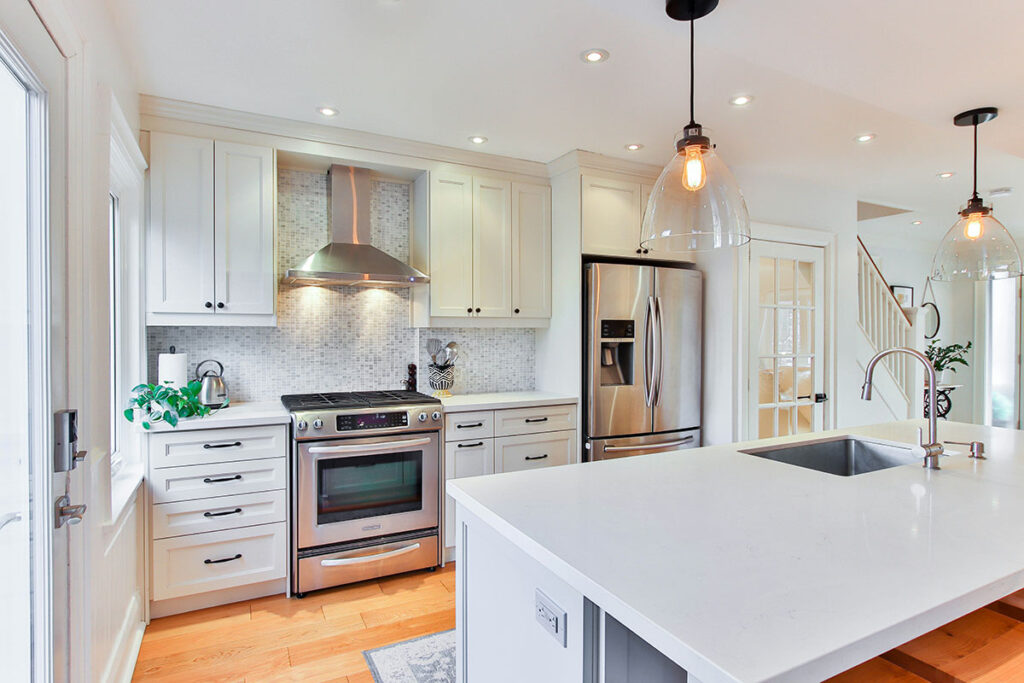
Buyers decide fast in kitchens. According to the National Association of Realtors’ Profile of Home Staging, an updated kitchen ranks as the single room most likely to help a buyer visualize the home as their own. That translates directly to offers. A functional, clean kitchen can push a buyer off the fence; a dated one tends to show up as a line item in their price reduction request.
That influence on buyers doesn’t mean you should spend without limits. Remodeling Magazine’s annual Cost vs. Value report consistently shows that major kitchen remodels recoup less than 50% of their cost at resale nationally, meaning a $60,000 gut renovation might add $25,000-$30,000 in value, not $60,000. Midrange remodels perform better. The practical conclusion: targeted, high-visibility improvements beat full overhauls for ROI, especially when your home’s price point doesn’t support a luxury kitchen without pricing it out of its neighborhood.
Table of Contents
The Refresh: High-Impact, Lower-Cost Updates
Before demoing anything, run through these refresh projects first. They cost a fraction of structural changes and produce the biggest visible difference per dollar spent.
Cabinet paint and hardware are the highest-ROI combination most homeowners overlook. Repainting dated oak or dark wood cabinets in a clean white or warm gray costs $200-$600 in materials if you do it yourself, or $1,500-$3,500 if you hire a painter. Add new pulls and knobs in brushed nickel or matte black and you’ve addressed the feature buyers most often flag as dated, without touching the cabinet boxes themselves.
Lighting is a resale factor most sellers underestimate. A single overhead fixture, especially a fluorescent panel, makes any kitchen feel smaller and older than it is. Replacing it with a layered approach, recessed cans for ambient coverage, under-cabinet LEDs for the countertop work zone, and a pendant above the sink or island, changes the room’s character at a fraction of the cost of a full remodel. Electricians typically charge $150-$300 per recessed can installed, depending on ceiling access.
A stained composite sink or corroded faucet is the kind of detail buyers notice and don’t forget. Swapping in a stainless deep single-basin sink ($150-$400) and a high-arc pull-down faucet ($150-$350) is a weekend project that removes a visible objection. The functional improvement, better depth, better water control, is real too, not just cosmetic.
The Upgrades: Mid-Range Investments with High Value
If the cosmetic updates above won’t be enough, either because the kitchen’s bones are significantly dated or because comparable nearby homes have already been renovated, these are the projects worth the larger spend.
Countertops carry disproportionate visual weight in a kitchen. Laminate and ceramic tile immediately read as dated to most buyers, but you don’t need to spend on marble to clear that bar. Quartz ($55-$100 per square foot installed) has become the baseline expectation in many markets for its scratch and stain resistance and consistent slab-to-slab appearance. Granite ($40-$75 per square foot installed) remains a strong choice in the Austin, Round Rock, and San Marcos markets specifically, Central Texas buyers are familiar with quality granite and respond well to it.
The backsplash punches above its weight for visual impact. Because the surface area is small, typically 15 to 30 square feet between the counter and upper cabinets, you can use a material that looks expensive without the budget to match. Classic 3×6 white subway tile runs $2-$5 per square foot installed and has stayed relevant across every kitchen trend cycle since the early 1900s. Neutral buyers won’t object to it; buyers who want something bolder can swap it after closing without touching anything structural.
Buyers walking through an open house clock mismatched appliances immediately, a black refrigerator next to a stainless dishwasher reads as “owner didn’t finish the job.” You don’t need Wolf or Sub-Zero. A coordinated stainless set from Samsung, LG, or GE covering the four essentials (fridge, range, dishwasher, microwave) runs $1,500-$3,000 and photographs well. The criteria are simple: same finish, clean, working. A spotless $800 dishwasher beats a grimy $2,000 one every time.
FAQs
What kind of ROI can I expect from a kitchen remodel?
Remodeling Magazine’s annual Cost vs. Value Report, the most widely cited benchmark in residential real estate, consistently shows minor kitchen remodels recouping 65-80% of their cost at resale, while major upscale renovations typically recover 40-60%. The gap exists because a $15,000 refresh hits the visible elements buyers actually react to, without the carry cost of moving plumbing or rewiring. Beyond the percentage, an updated kitchen shortens time on market, and that speed has real dollar value when you’re carrying a mortgage, taxes, and insurance during a listing period.
Is it better to paint my existing cabinets or replace them?
If the boxes are solid and the doors hang square, painting beats replacement on ROI almost every time. Cabinet replacement runs $8,000-$25,000 or more for a typical kitchen. Professional cabinet painting, proper prep, primer, and a sprayed finish, runs $1,500-$4,000 for the same space. Replacement makes sense in three specific situations: the frames have gone soft from water damage, the hardware is discontinued and the doors can’t be rehung reliably, or the layout is genuinely dysfunctional, think a galley so narrow two people can’t pass each other at the same time.
Are stainless steel appliances still the standard?
Yes. Black stainless and matte white have carved out niches in the luxury and minimalist segments, but classic stainless remains the dominant choice for resale, and the reason is buyer psychology. A buyer touring five homes in a weekend expects stainless; seeing it confirms the kitchen is current. Seeing fingerprint-prone black stainless or trendy matte white raises the question: “Will I still want this in five years?” Neutral sells. Stainless is neutral.
Should I splurge on granite or quartz countertops?
Both clear the bar; the practical difference comes down to maintenance. Quartz is engineered, non-porous, and never needs sealing, simpler to own and increasingly the default in new construction, which has shifted buyer expectations in many markets. Granite requires annual sealing and varies stone to stone, which some buyers love and others find unpredictable. In Texas specifically, granite still commands strong buyer recognition, it’s been a kitchen staple here long enough that quality granite reads as permanence rather than trend. Either material works; just avoid laminate at this price point, where it will look like a cost cut regardless of how well it’s installed.
How much should I spend on a kitchen remodel for the best ROI?
Spend between 5% and 15% of your home’s current market value and you’re in the range where the update shows without the cost outrunning what buyers in your neighborhood will actually pay. On a $400,000 home, that’s $20,000-$60,000. Below 5% and you risk a half-measure that doesn’t move the needle. Above 15% and you’re funding a renovation the market won’t fully reward, buyers in a $400k neighborhood don’t pay $500k prices regardless of how nice the quartz is.
Does a minor kitchen remodel offer a better return than a major one?
Yes, and Remodeling Magazine’s Cost vs. Value data has shown this consistently for more than a decade. Minor remodels, paint, hardware swaps, countertop replacement, appliance refresh, target exactly what buyers notice without touching the things that cost the most to change: plumbing relocations, gas line rerouting, structural wall removal. A $20,000 minor remodel recouping 70% returns $14,000 in added value. A $75,000 gut renovation recouping 50% returns $37,500, more raw dollars, but a far larger outlay for a smaller percentage gain. For most sellers preparing to list, the minor route is the more rational bet.
Are smart appliances worth the investment for resale?
Smart features rarely move the needle with buyers. What they actually evaluate is age, condition, and whether the appliances match. A cohesive stainless steel set that’s two or three years old will outperform a mismatched collection of Wi-Fi-enabled ones in almost every showing. Get the matching set right first, the connected features are a footnote.
Is quartz better than granite for a rental property?
For most landlords, yes. Quartz is non-porous, so it doesn’t need annual sealing, and tenants won’t do that maintenance anyway. Granite can look rough within a year of normal use if it goes unsealed: wine, coffee, and citrus leave marks. Quartz costs a bit more upfront but removes a recurring maintenance task and holds up better under hands-off ownership.
What is the most popular kitchen color for buyers?
White cabinets paired with grey or white quartz countertops still sell fastest in this market, they photograph well and don’t give buyers a reason to pause. That said, we’re seeing more traction with warm wood lower cabinets paired with white uppers, and sage green accents appearing in modern farmhouse builds across the Austin suburbs. All-white is still the safe bet, but it’s no longer the only palette that performs.
Spend Smarter, Not More
A kitchen remodel that pays off isn’t necessarily the most expensive one, it’s the one that hits what buyers in your market actually want. In Texas, that means clean finishes, a functional layout, and an aesthetic that doesn’t make buyers mentally redecorate before they’ve made an offer. Spend where it shows, skip what doesn’t move the needle, and you’ll see a better return than someone who spent twice as much on the wrong things.
If you’re weighing kitchen updates before listing, or just want to know which improvements are actually paying off in your neighborhood right now, the Lonestar Realty Team works in the CTX area daily and can tell you exactly where buyers are spending their attention.